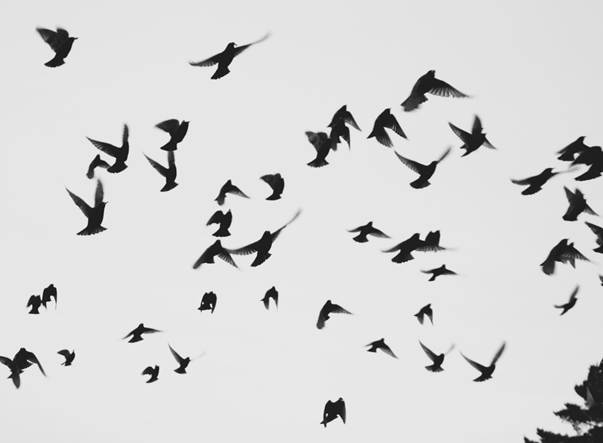
In last month’s blog, the first of a series of three exploring what it is to be creative, I introduced the topic by highlighting the importance for all living beings of the recognition of patterns. In the example I took, the individual members of a flock of starlings seeing off a predator recognise the (repeatable) pattern of the hawk’s profile, and their actions are guided by the (repeatable) patterns formed by the flight of their immediate neighbours and the flock (the “murmuration”) as a whole. The human (myself) watching the murmuration is seized by a sense of wonder at the co-ordinated patterns made by the multitude of birds.
An AI entity is trained to recognise recurring patterns across vast amounts of data. What marks the starlings and the human out from the AI entity is that the starling and the human are motivated in recognizing and producing a pattern by a sense of that particular pattern’s importance and value. This sense, this feeling, is rooted ultimately in an awareness (shared, albeit in different ways, by human and starling) of mortality. This is the difference between natural and artificial intelligence.
This month, I want to draw attention to two-aspects of this all-important pattern-recognition: its dynamic, temporal quality, and its dependence on particular points-of-view, particular construals. There is an interweaving here of process and perspective.
There is process because, clearly, the pattern of the starlings’ murmuration is not a static, fixed thing – it’s dynamic, unfolding. Also, the starlings’ recognition of the pattern of the hawk’s flight-profile is not given instantaneously, but built up over a (short) period of time. The same is even true of the AI entity, though here the time-period is reduced drastically. In all these cases, albeit in different ways, pattern-recognition, and pattern itself, is a process.
Similarly, in all these cases, the recognition of patterns involves a particular point-of-view that picks out this pattern, among all the possible features of the environment (all with their own patterns) on which attention could be fixed. In the case of the starlings and the human, that point-of-view is motivated by a feeling for its importance, its value, for life. In the case of the AI entity, the “point-of-view” is dictated by how it has been programmed.
One of the most fundamental instances of the way we humans see the world in terms of dynamic, unfolding pattern, of process, is the organization of sequences of events and actions into narratives. Small, mundane scraps of narrative play a vital role in the small child’s learning to navigate his/her way through a potentially baffling world. (Carer to toddler: “This is how we get dressed in the morning: first we. . . then we. . . and finally. . .!”) As is demonstrated in the classic of developmental psychology, Narratives from the Crib, the stories that a small child tells about him/herself to him/herself play a vital role in the development of language.
But narrative is not, of course, just a matter of language. It can be played out in action – and not just by actors on stage or screen, but in the fabric of our everyday lives. When the carer tells the toddler the little story about getting dressed in the morning, s/he is inculcating a habit – a recurring dynamic pattern of thought and action. Rituals are habits that have become imbued with a high level of importance for a community and/or individual. (In the case of ancient Greeks, the “Cambridge School” of classical scholars of the early part of the twentieth century demonstrated vividly how the celebrated verbal articulations of mythology grew out of the more fundamental wordless narratives of ritual.)
All these narratives, wordless or articulated in language, involve processes of transformation: the toddler dresses him-/herself, the god is appeased. . .
With language, perspective enters into narrative and becomes of vital importance. By manipulating little scraps of story, repeating and varying them, the developing child learns to articulate, for example, different temporal perspectives (such-and-such happened. . . such-and-such will happen. . . such-and-such might happen. . .) or different construals of appearance versus reality (seemed like. . . but actually. . .).
In extended written narratives, different perspectives on the unfolding of events set in train new dynamic patterns that play across the story. When I read a detective novel, I follow the detective as s/he investigates the murder: first s/he does this, then that, then the other. But my reading of this chronicle initiates in my mind other dynamic patterns, of conjecture. What happened “before” this chronicle began (i.e. who committed the murder?)? What is going to happen in the “future” (e.g. will the detective escape this situation of jeopardy into which his/her investigations have led?)? The skill of the writer lies in orchestrating these interweaving patterns of perspective, just as a composer manipulates unfolding patterns of rhythm and harmony.
Highly complex works of literary art can of themselves generate myriad unfolding perspectives, myriad “readings”. In terms of the history of the novel, Miguel de Cervantes’s Don Quixote is a seminal example of this. As the Knight of the Sad Countenance and his sidekick-servant Sancho Panza make their way through their various absurd adventures, they give to each other, and to the reader, their contrasting perspectives on events – one lofty, romantic and dotty, the other down-to-earth, deflationary and comic. But Don Quixote is far more than a simple satire on chivalric romance (though in one of its aspects, its possible “readings” it is just that). Even while laughing at him, the characters around Quixote are affected by the attraction of his personality. By the end, even Sancho Panza has begun to adopt the perspective of his master – while Quixote, with a twist of irony, has moved in the opposite direction, having lost his illusions and become to some extent Sanco Panza-ified. Shelves of books have been written, in many languages, on the possible ways of interpreting Don Quixote: it has the quality of a multifaceted jewel, presenting completely different appearances according to the light cast on it.
In next month’s blog, the last of this short series, I’ll endeavour to show how this interplay of process and perspective draws on the fundamental creativity of Nature itself, and marks the difference between natural intelligence and artificial intelligence.
*
Reference: Katherine Nelson, Narratives from the Crib (Harvard University Press, Cambridge MA, 1989)


Leave a Reply