Over the past twenty or thirty years, “creative” has become one of the most (over)used words in the language – there are university faculties of Creative Industries (I used to work in one), advertising has its “creatives”, the on-line world has its “content creators” etc. Like Freedom! and Democracy! it has become a “Hurrah word”: everyone agrees that creativity is a Good Thing, but overuse empties it of meaning.
At the same time, the advent of AI has seemed to place a question-mark over creativity. Many of those online “content creators” now use Large Language Models or other forms of AI to (in the marketing jargon) “unleash their creativity”. (Shamefully, some “writers” apparently do the same.) Could it be that in creativity, as in other fields, humans might be superseded by the machine?
Over the next three blogs, between now and the New Year, I want to offer my thoughts on creativity – what it is, and what it isn’t. My starting-point, this month, is our recognition of patterns.
*
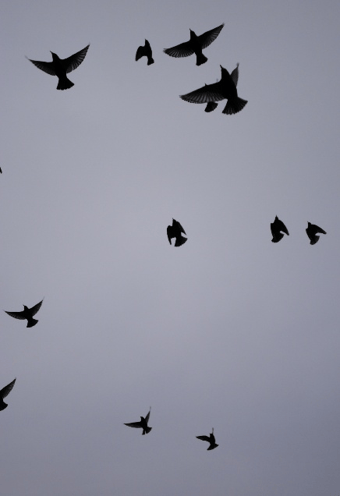
A couple of weeks ago, I witnessed an extraordinary ornithological phenomenon from my suburban back garden. The air was suddenly filled with starlings – around a couple of hundred of them. They descended into the trees and bushes, chattering loudly. From past observation, I guessed immediately what was going on: there was a predator about. Sure enough, a couple of seconds later a sparrowhawk appeared, soaring low over the garden fences.
Then things took an unexpected turn. Instead of lying low in the relative safety of the trees and bushes, the starlings, almost as one, rose into the air and formed a dense flock – a “murmuration”. Many people will have seen this spectacular sight, especially at dusk, when hundreds, sometimes thousands, of birds will form dense clouds, ever-mutating in shape, that wheel over the roosting site until they settle down for the night.
But this was different. For a start, it was the middle of the day. Also, it quickly became apparent that this murmuration had a singular purpose: to attack and drive off the sparrowhawk. For the next couple of minutes, I was treated to a spectacular aerial display of cat-and-mouse: for a few seconds the murmuration would pursue the sparrowhawk, then the sparrowhawk would wheel around and attack the starlings. The murmuration would break up into smaller, fleeing groups, only to reform and resume the attack. I watched, spellbound, until the whole unfolding drama had drifted away out of sight over the rooftops.
My fascination was with the dynamic patterns formed by the birds. Each individual starling, too, was perceiving patterns. In the first place, they recognised the hawk’s distinctive silhouette. When flying in the murmuration, according to ornithologist Wenfei Tong (Understanding Bird Behavior, Princeton University Press), a shadow of the flock is projected onto the bird’s retina, telling it whether it is in the middle or on the edge of the flock, and the bird constantly monitors both its distance from the birds immediately around it and their average alignment.
Both I and the starlings, then, were recognising patterns. In this respect we were doing exactly what AI does. The only difference is one of speed and complexity – AI entities are capable of recognising patterns across vast fields of data at lightning speeds. That is what makes them so useful in fields such as medical diagnostics. Large Language Models (ChatGPT etc) respond to prompts by scanning vast amounts of verbal information to recognise and reproduce preexisting patterns in the way language has been put together. There should be no surprise in this: AI is created by humans, it is an extension of the human mind, so it is perfectly natural that it should represent an aspect of that mind (an aspect shared by starlings and every form of organic life).
The recognition of pattern, then, is a thread that runs through the starlings, myself and the AI entity. But there is another, more fundamental, thread, that runs through the starlings and myself, but stops short of the AI entity. In the case of myself and the starlings, the recognition of pattern is animated by some feeling for the importance and value of the pattern and its recognition. In the case of the starlings, when they recognised the pattern made by the silhouette of the sparrowhawk, the importance was immediate and obvious – a matter of life and death. When it comes to myself watching the starlings, the importance is harder to define. In considering the feelings of wonder and curiosity I experienced in that moment, it is easy to say that they mark me out as human, as distinct from the starlings. But perhaps we should not be so hasty – birds certainly exhibit curiosity. What is certain is that the AI entity feels neither my curiosity and wonder, nor the starlings’ sense of danger.
For myself and the starlings, there is always something beyond and behind the pattern – animating it, lending it significance. This sense of significance, of value and importance, is an emotion, a feeling – it is felt in the body. In the case of the starlings, it is transmitted immediately into bodily movements. In my case, a physiologist would be able to identify subtle changes in the state of my body brought about by my wonder and curiosity. The AI entity, by contrast, has no body. It is true that it operates on a material substrate of silicon microchips, but there is no intrinsic connection between the pattern-recognition and the body, as there is for myself and the starlings.
To have a body is to know one’s own mortality. The starlings had a keen, immediate sense of their own mortality when they recognised the pattern of the sparrowhawk’s silhouette. My own sense of wonder, watching the patterns made by the starlings’ murmuration, can also, ultimately, be traced back to that same sense of the mortality of my body – to the desire to fill my life with as much significance as possible before it is over. The AI entity knows none of this. (One shouldn’t at this point make the mistake of concluding “Oh, so AI entities are immortal!” ‘Immortality’ only has meaning in a context of mortality. Without mortality there is no immortality – there is nothing.) With possession of a body, and with it the knowledge of mortality, also comes a feeling of time. Our bodies – with their growth, decay and eventual death – are direct expressions of duration. Of this, too, the AI entity knows nothing. It has no knowledge of lived time. It would be incapable of experiencing the unfolding of those moments when I watched the murmuration, against the backdrop of my life and death.
In next month’s blog, I’ll continue by exploring the relationship between patterns and creativity.


Leave a Reply