This is American poet Hart Crane in an April 1923 letter to the celebrated photographer Alfred Stieglitz, praising Stieglitz’s “Apple and Drops of Rain”:
The eerie speed of the shutter is more adequate than the human eye to remember, catching even the transition of the mist-mote into the cloud, the thought that is jetted from the eye to leave it instantly forever. Speed is at the bottom of it all – the hundredth of a second caught so precisely that the motion is continued from the picture infinitely: the moment made eternal.
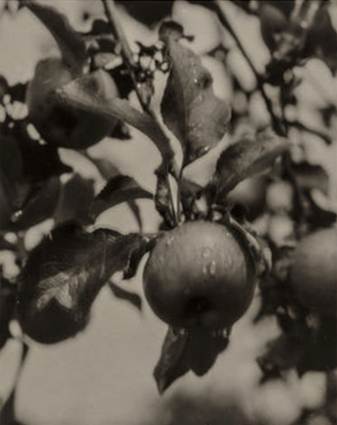
Alfred Stieglitz, “Apple and Drops of Rain, Lake George, 1922”
The moment made eternal. . . It wouldn’t make a bad definition of the short story. The short story, like the photograph, is marked by concision and focus – by what it leaves out (the “blind field”) as much as what it includes. Writing at a time when photography as in its infancy, Edgar Allen Poe defined the short story as a narrative that can be read at one sitting (“requiring from a half-hour to one or two hours for its perusal”) and identified its key characteristic as its unity of impression – as opposed to the episodic character of the novel.
This is how Argentine-French writer Julio makes the same comparison between short story and photograph (Cortázar’s own short stories include “Blow Up”, a story in which photography plays an important, and which was turned into celebrated film in the 1960s):
I don’t know if you have ever heard a professional photographer talk about his art; I have always been surprised by the fact that, in many cases, they talk much as a short-story writer might. Photographers like Cartier-Bresson or Brassai define their art as an apparent paradox: that of cutting off a fragment of reality, giving it certain limits, but in such a way that this segment acts like an explosion which fully opens a much more ample reality, like a dynamic vision which spiritually transcends the space reached by the camera. While in films, as in the novel, a more ample and multifaceted reality is captured through the development of partial and accumulative elements, which do not exclude, of course, a synthesis which will give a climax to the whole work. A high quality photograph or story proceeds inversely; that is, the photographer or short story writer finds himself obliged to choose and delimit an image or an event which [. .] is capable of acting on the viewer or the reader as a kind of opening, an impetus which projects the intelligence and the sensibility toward something which goes well beyond the visual or literary anecdote contained in the photograph or story.
Short stories are often centred around a particular turning-point in the protagonist’s life (an “epiphany”) – a moment that seems to encapsulate an entire life. Thus while the dramatic time of the narrative may be short (it may, for example, recount a single conversation or encounter between two characters), that short duration seems to contain within itself much longer durations – sometimes the duration of a whole lifetime.
We find this same compression of multiple durations within a single “moment” in photography too. Clive Scott, Street Photography: From Atget to Cartier-Bresson (2007) gives a beautiful example of this in his analysis of André Kertész’s “Steps of Montmartre”(1927).
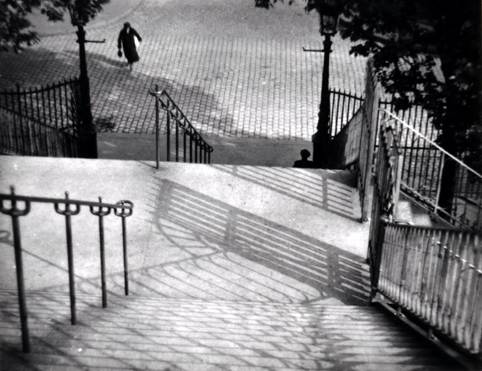
Scott shows how the image’s power and poignancy lies not so much in its formal, purely spatial composition, as in the concurrence of different “speeds” or durations represented by the shadows (the cyclical passage of night and day) and by the objects and people:
The railings are moving faster through existence than the trees, whose cyclical time is also more resilient than the linear time of the human figures; the male figure sitting at the base of the lamp post borrows some of the lamp post’s immutability, while the walking woman is peculiarly alone in her transience.
Given the way both art-forms compress time and seek out the single pregnant “moment” it’s not surprising that many short story writers have, like Cortázar, been fascinated by photography as theme in their fictions (as documented in Jane Rabb’s The Short Story and Photography 1880s – 1980s). Some short story-writers, like Eudora Welty, have been serious professional photographers as well as writers.
For any of us, if you’re looking for inspiration for a new story – looking for new ways to play games with time – there are worse places to start than with some old snapshots. . .
 Adam Lively: Writer - Literary Mentoring and Coaching
Leave a comment