Want a brief escape from the gaudy mirth of Christmas? Fancy a tinsel-free zone? For this second of a short series on the relations between photography and fiction, I take you into the shadow-filled, melancholic world of W.G. Sebald’s fiction, and show how his powerful use of photographs draws on wider, deeper links between photography and death. . . Think of it as my personal contribution to Seasonal Good Cheer.
In last month’s blog, I argued that if photos are going to be used, they should be integral to the text: “Photographs in a work of fiction shouldn’t be thrown in willy-nilly, as a gimmick, a decoration or to fill in lazy gaps in the text (‘Hey, I don’t need to evoke this place/person/event in the reader’s mind – I can just bung in a photo’): between photographs and text there should ideally be a deep, inner affinity and connection.” Sebald’s use of photography and text, in books such as the story-collection The Emigrants (1993) and the novel Austerlitz (2001), is not only a model of such integration: it also embodies a distinctive attitude towards the nature and significance of the photograph, and the role that it plays in our lives.
Born in Germany (in 1944), and writing originally in German, Sebald lived most of his life in the UK (he died in 2001). Much of his writing deals with fragile traces and memories of those who have been swept aside by the terrible tides of European history, especially in the mid-twentieth century. Grainy black-white-grey photographs are deeply embedded in the winding, meditative narratives, as precious relics of a past (once a present) that is now irretrievably lost:
Again and again, from front to back and from back to front, I leafed through the album that afternoon, and since then I have returned to it time and again, because, looking at the pictures in it, it truly seemed to me, and still does, as if the dead were coming back, or as if we were on the point of joining them. (The Emigrants)
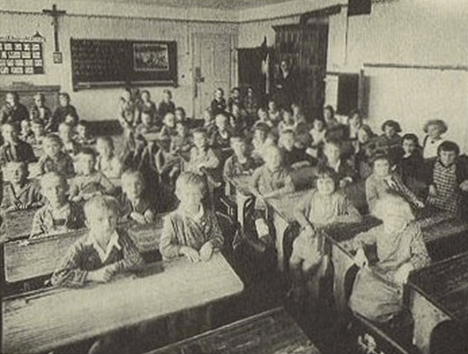
The old photograph puts the living in touch with the dead: it is a physical trace of the dead. André Bazin, in his essay ‘The Ontology of the Photographic Image’ (1945), traces the origins of photography back to such practices as Egyptian mummification: it is, he writes, a “transference of reality from the thing to its reproduction.” The photograph is, in the words of Roland Barthes, “not a ‘copy’ of reality, but an emanation of past reality: a magic.”
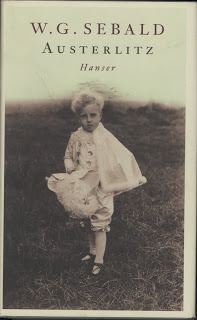
This haunting of photographs by death – and the haunting of the living by the photographs of the dead – plays a leading part in Sebald’s narratives. The eponymous protagonist of Austerlitz, Jacques Austerlitz, is an amateur photographer, and many of the moody, grainy black-and-white photos that run through the book are purportedly taken by him. The only photograph of Austerlitz shows him at the age of five, dressed in a pageboy costume (see above). It is the only surviving relic, the only trace, of his life in Prague before the Second World War – before he was put on a Kindertransport for England, before his parents disappeared forever in the Holocaust, before his memory was obliterated. The moment towards the end of the novel when Austerlitz, now an old man, is shown this photograph for the first time, is all the more moving for Sebald’s lucid, undemonstrative prose-style:
“That evening in the Športova, when Vĕra put the picture of the child cavalier in front of me, I was not, as you might suppose, moved or distressed, said Austerlitz, only speechless and uncomprehending, incapable of any lucid thought. Even later nothing but blind panic filled me when I thought of the five-year-old page.”
“I always felt the piercing, inquiring gaze of the page boy who had come to demand his demand his dues, who was waiting in the grey light of the dawn on the empty field for me to accept the challenge and avert the misfortune lying ahead of him.”
The photograph, embodying the reality of the past, has an uncanny quality that challenges our easy, commonsense notions of linear time, of life and death:
“It does not seem to me, Austerlitz added, that we understand the laws governing the return of the past, but I feel more and more as if time did not exist at all, only spaces interlocking according to the rules of a higher form of stereometry, between which the living and the dead can move back and forth as they like, and the longer I think about it the more it seems to me that we who are still alive are unreal in the eyes of the dead, that only occasionally, in certain lights and atmospheric conditions, do we appear in their field of vision.”
In the New Year, I’ll conclude this short series of blogs on photography and fiction by reflecting on the affinities between the photograph and the short story. . .
In the meantime, a merry, multicoloured Christmas to all!
 Adam Lively: Writer - Literary Mentoring and Coaching

Leave a comment