This is the first of a planned short series of blogs on the relationship between fiction and photography. My interest in this topic is creative rather than merely antiquarian or academic – hopefully, these blogs will provide reflections that could be useful for anyone, like me, interested in the possibilities of combining the two forms.
To my knowledge, the first novel to include photographs as an integral part of its text was Georges Rodenbach’s Bruges-la-Morte (1892) – a fascinating and memorable short novel (still in print and available in more than one English translation) that, among other things, was an indirect influence on Alfred Hitchcock. . .
In his Foreword to Bruges-la-Morte, Rodenbach (a Belgian symbolist poet and member of Stéphane Mallarmé’s famed literary circle) writes that the thirty-five photographic views of Bruges incorporated in the text were intended to play more than just a decorative or illustrative role:
It is the town which directs all that occurs there. . . its urban landscapes are not mere backdrops, settings selected almost haphazardly, but are fundamentally linked to the main action of the novel.
It is because of this essential connection between these scenes of Bruges and the events described in the story that photographic reproductions of the former have been inserted in the text – the quays, deserted streets, old dwellings canals, béguinage, churches, goldsmith’s shops where sacred objects are made, belfries, – so that all those who read this work may themselves feel the presence and the influence of the city, experience the contagiousness of the waters, and be conscious of the long shadows of the high towers as they fall across the text.
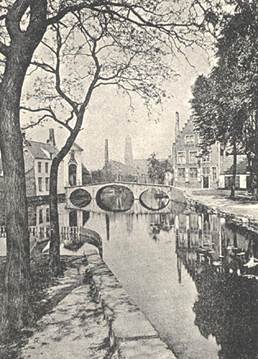
Photograph from Bruges-la-Morte
Hugh Viane, Rodenbach’s protagonist, is a widower paralyzed with grief for his young, dead wife, with whom he had spent ten years of married bliss. He has sought out Bruges, a silent, brooding city of canals and churches, because it corresponds with his own state of mind:
A mysterious equation established itself between his own spirit and that of the place. In the eternal fitness of things a dead town furnished the corresponding analogy to that of a dead wife . . . His longing was for an infinite silence into which no disturbing note ever penetrated, and an existence so exempt from feverishness that it should resemble a species of Nirvana.
The silent melancholy of the town is not only a symbol, for Viane, but an all-pervasive experience. He is given to solitary wandering, to immerse himself in this symbolic mediation of his grief:
At the approach of the evenings, he derived a melancholy solace from the analogies which he devised between the mournfulness of his own destiny and that of the forsaken canals and decaying churches that instinctively attracted his footsteps.
Analogies and resemblances are key to this strange and haunting novel: during one of his wanderings, Viane sees a woman in the street who bears a striking resemblance to his dead wife. Especially striking is her “strangely characteristic amber-coloured hair”, which matches exactly his dead wife’s hair, locks of which he keeps in a household shrine to his beloved. He follows the woman, becomes obsessed with her, and they form a relationship. Jane, the woman he has fixed on, is an actress (and, it is inferred, a prostitute) who proceeds to manipulate and steal from Viane. I won’t spoil things by giving away the end – suffice to say that it doesn’t end happily. . .
The book was a critical and commercial success in the 1890s, and has had an interesting afterlife. As early as 1915 it was turned into a film, in Russia, then put on stage as an opera by Erich Korngold in 1920. Its narrative device of the doppelgänger of a beautiful woman is thought to have been a strong influence on the 1954 novel The Living and the Dead by Boileau-Narcejac (the pen-name of co-writers Pierre Boileau and Pierre Ayraud), on which Alfred Hitchcock based his film Vertigo (1958). What can we learn from Rodenbach’s pioneering use of photography? A crucial point, I think, is that the photographs are integral to the text: in the case of Bruges-la-Morte, their use reflects those themes of resemblance and reflection, and of memorialization of the past and the dead, which give the novel its sombre power. (In a future blog I’ll explore how a writer nearer our own time, W.G. Sebald, has also drawn on the photograph’s quality as relic of the past and of the dead.) So perhaps the positive lesson to be drawn from Rodenbach’s example is the simple, basic and perhaps obvious one that photographs in a work of fiction shouldn’t be thrown in willy-nilly, as a gimmick, a decoration or to fill in lazy gaps in the text (“Hey, I don’t need to evoke this place/person/event in the reader’s mind – I can just bung in a photo”): between photographs and text there should ideally be a deep, inner affinity and connection. . .
 Adam Lively: Writer - Literary Mentoring and Coaching
Leave a comment